
Alignment Without Accountability Is Theater
The third and final story in the AAA Triangle series — where clarity meets consequence.

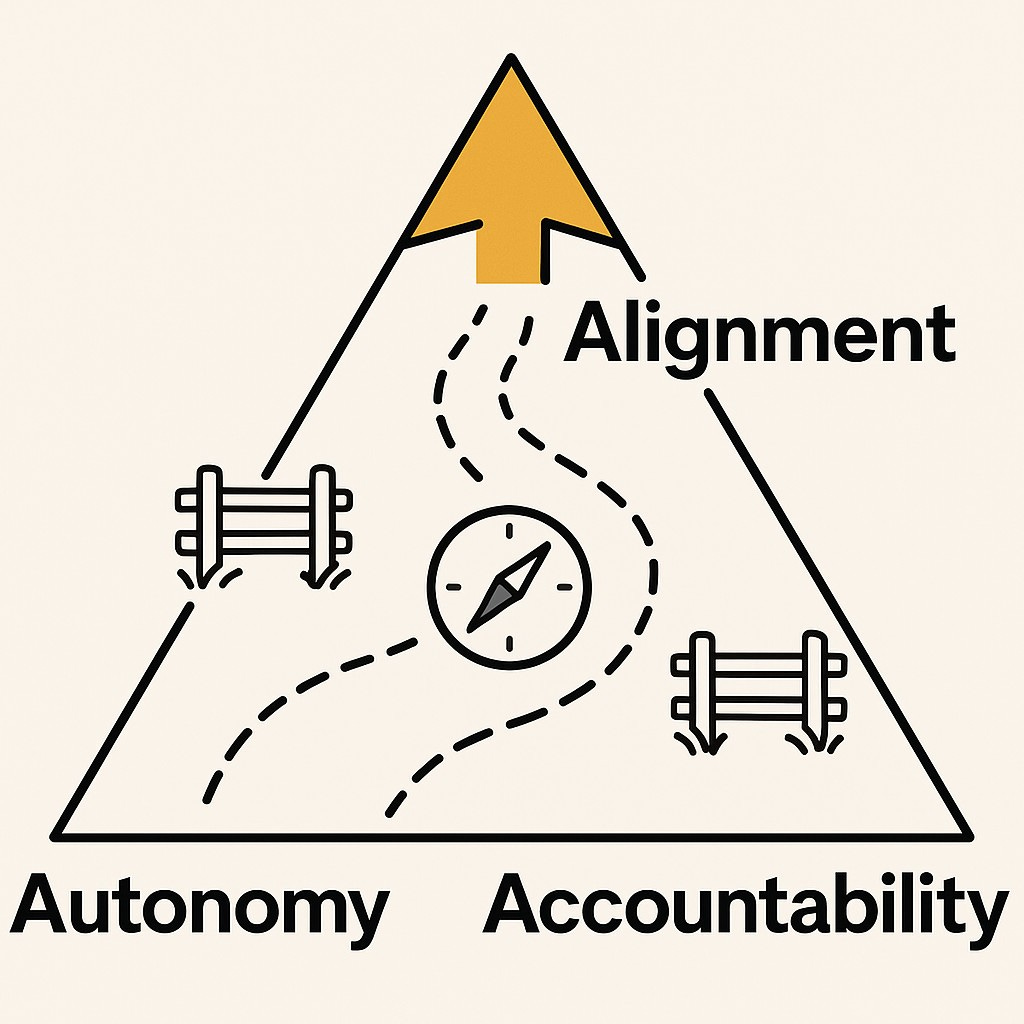
“Alignment gives purpose. Accountability keeps it honest.”
Scene 1 – The Illusion of Alignment
The slide deck glowed like a sunrise: every metric green, every voice polished. “Alignment achieved,” read the headline on the final slide. Applause rippled politely across the room.
Arin clapped, but softly. The air smelled of confidence and coffee—the familiar scent of corporate theater. She’d seen it before: smiles rehearsed, nods synchronized.
If this were true alignment, she thought, why does it feel so brittle?
Across the table, Jordan was already sketching next-quarter targets in his notebook. Leila caught Arin’s glance and offered a small shrug—a silent you feel it too?
The CEO’s voice droned through another slide of “strategic coherence.” It reminded Arin of a conversation she’d had months earlier with a colleague from Bayer. Thirteen management layers, he’d said. A bureaucracy Kafka would envy. They tore it down with Dynamic Shared Ownership—and found clarity hiding underneath the rubble.
TitanCorp wasn’t there yet. Here, alignment still lived in PowerPoint, not in practice. Everyone agreed because it was safer than asking whether the numbers meant anything.
Arin leaned toward Jordan. “If we’re all aligned,” she whispered, “why does it feel like we’re off key?” Jordan didn’t look up. “Because everyone’s hitting their own note,” he murmured, “and the melody’s gone.”
The applause swelled again. The meeting closed. The lights brightened. On the surface, everything was fine. But as people filed out, Arin noticed the quiet—that telltale hush when a room full of leaders knows something’s missing and no one names it.
Alignment without accountability, she thought, looks perfect until the curtain falls.
Scene 2 – The Tension of Clarity and Consequence
By afternoon, the adrenaline of the review had faded. The whiteboard room hummed with quiet frustration.
Jordan stood at the board, marker in hand, drawing three boxes labeled Customer Success. Riya interrupted, arms crossed. “Hold up—those don’t match mine.”
He turned, eyebrows raised. “They’re the same outcomes.” “They’re not,” she said, tapping her tablet. “In Ops, ‘customer success’ means renewals. In Product, it means adoption. In Service, it’s NPS. Three teams, three truths.”
The room went still. Leila sighed, leaning forward. “This is what happens when alignment stops at the slide deck.”
Ethan, standing near the window, drew the familiar triangle—Alignment ↔ Autonomy ↔ Accountability—and circled one corner until the ink bled through. “This one,” he said quietly, “is fading fastest.”
Arin watched the circle darken, remembering her friend from Bayer again. Thirteen layers down to three. Ninety-day cycles instead of annual check-ins. Alignment rebuilt through real outcomes, not rhetoric.
She turned back to her team. “We’ve been treating alignment like a broadcast,” she said. “But the message mutates on every floor. The more we repeat it, the less it means.”
Harsh nodded. “And without accountability loops, nobody calls out the distortion. Everyone reports green until the customer turns red.”
Jordan dropped his marker. “So what’s the fix? More meetings? Another alignment summit?” Leila shook her head. “No. Fewer hand-offs. Shorter cycles. We need our own version of Bayer’s ninety-day rhythm—something that keeps alignment and accountability breathing in the same room.”
Arin leaned forward. “Let’s try this: every team defines its own outcomes for the next quarter, but ties them directly to one shared customer promise. If they drift, we’ll see it in real time, not six months later.”
Ethan smiled faintly. “Guardrails, not gates.”
The phrase hung in the air—borrowed from another company’s experiment, but instantly theirs.
Arin capped the marker and stepped back. The triangle still gleamed on the board, edges uneven but connected.
“Alignment dies from distortion,” she said. “Accountability’s how we hear when the note goes flat.”
Scene 3 – Re-Engineering Accountability
A glass-walled conference room overlooked TitanCorp’s courtyard. Night. The office mostly dark, city lights flickering against the windows. Coffee cups, half-erased sketches of triangles, and fatigue hung in the air.
Leila pulled the last sticky note from the wall. “So, we agree—our alignment signals die somewhere between intent and impact.”
“Somewhere between slide ten and the customer,” Jordan muttered.
Arin smiled, tired but alive. “Then we rebuild the bridge—but not by adding more decks or dashboards.”
She drew a simple loop on the whiteboard—an infinity symbol that cut across the triangle from earlier.
“Alignment gives purpose,” she said. “Accountability keeps it honest. They have to talk to each other continuously, not quarterly.”
Ethan leaned back, rubbing his eyes. “Bayer did that by switching to ninety-day cycles. No year-long theater. Real-time correction.”
“Right,” Arin said. “But we’re not Bayer. Let’s find our own cadence.”
She turned to the team. “What if we redesigned accountability as something people wanted to engage with?”
Silence, then Harsh spoke. “That means stripping out punishment. Making it feedback-centric.”
“Exactly,” Arin said. “Accountability isn’t a stick. It’s a mirror.”
Leila nodded. “So we need guardrails, not gates. Guardrails keep us safe; gates make us wait.”
Arin uncapped a red marker and wrote across the glass:
Performance-Driven Alignment Statement – The 90-Day Rhythm
We align around outcomes, not outputs. Every 90 days, each team delivers one result that clearly advances TitanCorp’s strategic promise—visible, measurable, and owned.
The room went quiet as everyone read it. It wasn’t flashy, but it landed.
Ethan broke the silence. “That’s not just a slogan. That’s how we make alignment visible.”
Arin nodded. “And that’s how accountability becomes a design choice, not a demand.”
She turned back to the glass and wrote four words beneath the statement: Visionary. Architect. Catalyst. Coach.
“These roles make accountability real,” she said. “Visionaries align intent. Architects design clarity into the system. Catalysts keep it alive. Coaches make it safe.”
Harsh scribbled on his pad. “So our experiment: next quarter, four-team pilot. Shared customer promise, ninety-day rhythm, feedback reviews led by coaches, not controllers.”
Jordan smirked. “And if it fails?”
Arin capped the marker. “Then we learn faster than last time.”
The group laughed softly—half nerves, half relief.
Outside, the lights from the courtyard reflected faintly off the glass, four words glowing in reverse: Coach Catalyst Architect Visionary.
For the first time all week, the triangle on the board didn’t look fragile. It looked alive.
Scene 4 – From Theater to Truth
Early morning at TitanCorp. The building hummed quietly before the day’s meetings began. Arin stood alone in the strategy room, the faint sunrise catching the words still scrawled across the glass: We align around outcomes, not outputs.
She traced the red marker lines with her finger. Overnight, someone had added small check marks next to the pilot teams’ names—an unspoken signal that work had already begun.
The room felt lighter than it had a week ago. Maybe because clarity, once an act of theater, now had a stage worth standing on.
Ethan stepped into the doorway, coffee in hand. “You ever notice,” he said, “when alignment is real, you don’t have to sell it? It just… shows up.”
Arin smiled. “You can see it in the room before you see it on a slide.”
They stood in silence, looking at the triangle drawn across the glass. It was worn now—smudged from hands and notes and late-night edits—but stronger for it.
Arin said softly, “Alignment without accountability is theater. But when they move together—clarity with consequence—it becomes trust.”
Ethan nodded. “The hard part isn’t finding alignment,” he said. “It’s keeping it honest.”
She uncapped the marker one last time and wrote beneath the triangle: Clarity is maintained, not declared.
That would be their mantra for the next quarter.
Outside, the first employees began to arrive. Arin stepped back, watching the reflections of her team gathering in the glass—Visionary, Architect, Catalyst, Coach—all heading into a day that no longer needed a performance.
The curtain, she thought, had finally lifted.
💡 Closing Reflection – The Triangle Complete
Across three stories, the TitanCorp journey traced the fragile geometry every enterprise wrestles with: Alignment, Autonomy, and Accountability.
In The Triangle AI Won’t Fix, Arin’s team learned that freedom without direction drifts—alignment gives autonomy its aim.
In Autonomy Without Accountability Is a Sugar High, they saw that energy without ownership collapses—accountability gives autonomy its integrity.
And here, in Alignment Without Accountability Is Theater, they discover that clarity without consequence decays—accountability gives alignment its truth.
The three tensions complete the triangle, but they don’t end the journey. Each side strengthens the others; each must be re-balanced as context shifts.
In adaptive organizations, alignment isn’t a once-a-year offsite; it’s a living dialogue. Autonomy isn’t a license; it’s a trust. Accountability isn’t control; it’s coherence made visible.
Together they form the discipline of clarity—the daily practice that keeps a company honest, human, and in motion.
💬 Leadership Practice Callout
Practice: The 90-Day Rhythm Every 90 days, revisit your alignment statement. Ask:
Did our outcomes advance our shared promise?
Where did clarity drift?
How will we refresh accountability to keep it alive?
This rhythm transforms alignment from a declaration into a daily discipline.
✍️ Author’s Note
This trilogy—The Triangle AI Won’t Fix, Autonomy Without Accountability Is a Sugar High, and Alignment Without Accountability Is Theater—marks the close of the AAA series. Each explores a different side of the geometry that holds adaptive organizations together. Thank you for reading, reflecting, and sharing these stories.