
The Experience Trap: When Wisdom Becomes a Wall
Why Some Leaders Evolve with Experience—And Others Fossilize

Context: Why This Matters Now
In an era of AI-native companies moving at algorithmic speed—faster, cheaper, and seemingly smarter—the value of human experience is under pressure. Many established leaders, from PMs to board members, tout decades of experience as their edge. Yet in adaptive environments, experience can be either a superpower or a speed bump.
Arin, as VP of Strategic Outcomes, sees this tension playing out daily. She leads enterprise-wide transformation, helping teams navigate ambiguity, deliver real value, and evolve how they measure success. Her challenge? Helping leaders discern when their experience still illuminates the path ahead—and when it casts shadows instead.
Across industries, leaders are quietly asking themselves:
Is my experience accelerating insight—or resisting change?
When should I trust what I know—and when should I unlearn?
How do I distinguish wisdom from reflex?
These aren’t philosophical questions. They’re operational ones. The default assumption is that more experience equals better judgment. But in fast-shifting environments, that assumption breaks down—sometimes dangerously. The real challenge isn’t where you are on the scale—it’s knowing when to move. The tension is between honoring what worked… and letting it go in time to adapt. Transformation doesn’t stall from lack of knowledge—it stalls when leaders stop learning.
And the tension isn’t binary. Imagine a 1–10 scale:
1 = Ossified — Experience has hardened into ritual and resistance.
10 = Unbounded — Every new situation treated as if nothing prior applies.
Where a leader lands on that spectrum—and whether they know when to shift—is a judgment challenge of the highest order. The more volatile the environment (like today’s AI-accelerated pace), the harder it gets.
Consider Rob Hall, one of the most experienced mountain guides on Everest. In 1996, despite deep knowledge of the mountain’s risks and turnaround rules, he delayed descent to help his client summit—and died in the storm that followed. His experience didn’t fail him—it was overridden in a moment of emotional and reputational weight. That’s the real trap: when judgment is accurate, but unused.
Even the most experienced leaders can falter when values, pressure, and real-time decision-making collide. That’s why understanding how we use experience—not just accumulate it—is vital.
Arin had seen it before. A pilot project stalls—not because it’s poorly designed, but because someone in the room leans on their experience like a shield. Experience, the great teacher, suddenly becomes a gatekeeper.
At a recent leadership meeting, three of her most trusted colleagues illustrated the paradox perfectly.
Ethan, the Enterprise Architect, carried decades of experience navigating complex systems. Yet his voice remained open and precise. "This architecture might succeed if we treat it as a living system," he said. "We’ve seen failure before, but this setup feels different—more adaptable. Let’s test it in a way that failure teaches."
For Ethan, experience wasn't an anchor—it was fertile ground. What mattered wasn’t what had worked before, but what could emerge if they kept learning.
Jordan, the Delivery Director, was harder-edged. "Every so-called 'bold idea' ends the same," he muttered. "Blown budgets, metrics in the red, and damage control. We’ve already learned this lesson."
Jordan wasn’t wrong. But his experience had hardened. What once served as insight had calcified into avoidance. Arin could feel it: his judgment wasn’t growing—it was closing in.
Then Leila, the Team Coach, offered something different. "After my last project crashed I stopped saying yes to anything risky. I thought I was protecting the team. But I realized I was just protecting myself—from being wrong again."
She paused. "Now I try to separate my scar tissue from my sensemaking. I still say no sometimes—but I know why."
The Fork in the Path
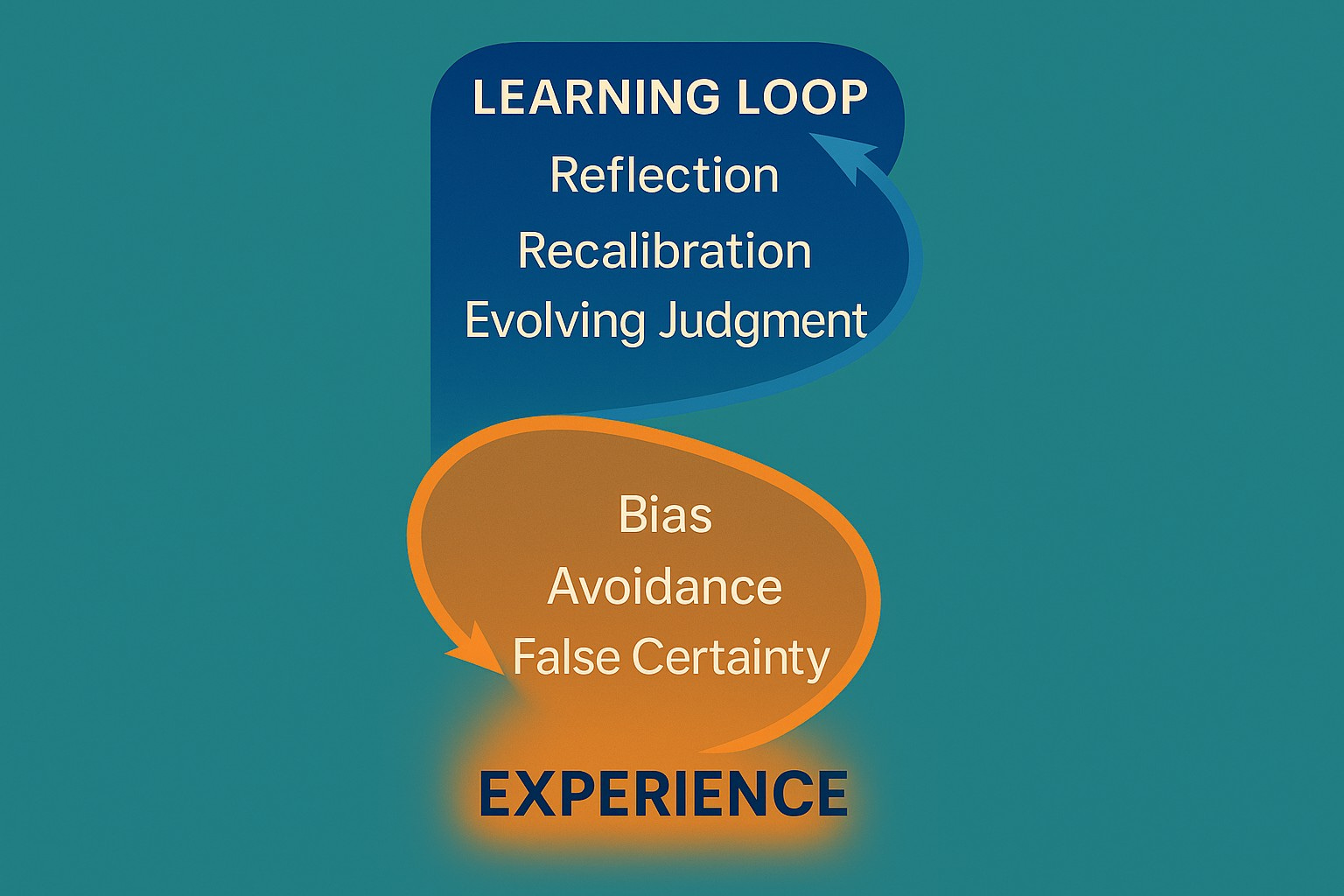
After the meeting, Arin lingered at the whiteboard, studying the two curved arrows she’d hastily drawn—one looping upward, the other curling downward from a single point marked Experience.
“Experience always leads somewhere,” she thought. “But the direction depends on what we do with it.”
She labeled the top loop: Reflection. Recalibration. Evolving Judgment.
And the bottom one: Bias. Avoidance. False Certainty.
Ethan’s path was clearly the top—still tilling fertile ground. Jordan had been slipping down the other. Leila was the pivot—someone clawing her way back up.
What disturbed Arin most wasn’t the mistakes—they were part of the job. It was when experience hardened into false certainty. When “we’ve seen this before” became a way to end discussion, not expand it.
She snapped a photo of the sketch and wrote a prompt for her next leadership session:
“Which loop are you in?”
The Research Behind the Reflection
Leadership science backs this tension. Experience is a powerful input into judgment—but only if it's refined through feedback and reflection.
Early experience often enhances decision-making. It speeds up pattern recognition and reduces over-analysis.
Later experience, if unexamined, often hardens into biases: confirmation, availability, and status quo bias are common.
Without reflection, experience turns from data into dogma.
This is why our Adaptive Leadership model treats judgment as a dynamic capability—not a fixed trait. It’s not just theory—adaptive judgment can be taught, coached, and developed. But only when leaders stop treating experience as untouchable. Great judgment isn’t just having been through a lot—it’s knowing how to interpret what you’ve been through.
From this view:
Ethan reflects the positive arc: experience that continues to build capability through openness, learning, and re-calibration.
Jordan illustrates the plateau—or even decline: experience that protects, deflects, and shuts down emergence.
Leila shows the pivot: the moment reflection reactivates growth.
Adaptive Reflection: The Anti-Calcification Agent
Our field research and capability model define Adaptive Reflection as the key differentiator. Leaders who practice it:
Revisit past decisions without justification or blame
Create time and space for sensemaking, not just action
Encourage others to challenge assumptions—even hard-won ones
Turn retrospection into readiness rather than regret
By contrast, leaders who stop reflecting tend to drift into what some call "ossified wisdom." They become masters of what was—but blind to what’s becoming.
A Question for Every Leader
At the end of the session, Arin jotted a note in her journal:
"Experience is either fertile ground—or a bunker. The difference is reflection."
Then she drafted a question she’d ask each of her VPs in their next 1:1:
“What part of your experience still teaches you something new—and what part might be getting in your way?”
That’s how adaptive capability is built. Not by rejecting experience—but by putting it back in motion.
Quick self-check for leaders:
Am I open to being wrong about something I’ve long believed?
Do I treat experience as a starting point—or a stopping point?
When was the last time I changed a decision based on feedback?
This article is part of the Adaptive Edge series. Follow for more insight into leadership capabilities that sustain transformation across uncertain terrain.